

Last Updated: October 25, 2026
Quick Summary
To recycle grooming packaging, empty and rinse each container, separate caps and pumps, check your council's acceptance list, then squash and bin rigid bottles coded 1, 2, or 5. Pumps, aerosols, blades, sachets, and mixed-material packs usually need a store take-back scheme or household waste recycling centre instead of the kerbside bin.
- Rigid bottles coded 1, 2, or 5 are the easiest kerbside wins; rinse, remove the cap, squash, and bin.
- Anything coded 4, 6, or 7, or with no code, needs a second look before going near your recycling bin.
- Remove pumps and spray tops and recycle only the bottle unless your council accepts them together.
- Recycle aerosol cans only when completely empty, and never pierce or crush them yourself.
- Keep a bathroom box for non-kerbside items and take it to a drop-off point once a month.
Table of Contents
- Why Grooming Packaging Waste Adds Up Fast
- Know Your Materials Before You Sort
- Step-by-Step: How to Recycle Cosmetic Packaging at Home
- Recycling Pump Bottles and Spray Tops Without the Guesswork
- Recycling Aerosol Cans from Shaving and Styling Products
- Razor Blade Recycling: What to Do with Blades and Cartridges
- Hard-to-Recycle Items and Specialist Take-Book Options
- Reuse and Repurpose Empty Containers Before You Bin Them
- Frequently Asked Questions
Why Grooming Packaging Waste Adds Up Fast
Most men's grooming routines generate more packaging waste than anyone stops to count.
The problem is that much of this packaging never gets recycled. Small containers slip through sorting. Pumps and caps confuse people.
At 99 Ninety Nine, we design our tubes to be fully recyclable and biodegradable, because we think packaging should not outlive the product inside it.
Below, we show you exactly how to handle each container type, including the awkward items most guides ignore.
Know Your Materials Before You Sort
Recycling success starts with knowing what you are holding. Grooming packaging falls into four broad groups, and each one behaves differently at the kerbside. But the single most useful skill is reading the material marking on the pack itself, because a container that says "recyclable" is not automatically accepted where you live.
Check the base, the back label, or the underside of the cap for a resin code (a triangle of arrows with a number 1-7 inside) or a material symbol such as "PET", "HDPE", "PP", "GL" for glass, or "ALU" for aluminium. If there is no marking at all, treat the item as non-recyclable until your council confirms otherwise.
What the Resin Codes Mean in Practice
| Code | Material | Common Grooming Items | Kerbside Reality |
|---|---|---|---|
| 1 | PET | Some shampoo and body wash bottles, clear spray bottles | Widely accepted; rinse and squash |
| 2 | HDPE | Shampoo bottles, some deodorant sticks, milk-style opaque bottles | Widely accepted; rinse and squash |
| 3 | PVC | Rare in modern grooming; some older blister packs | Rarely accepted at kerbside |
| 4 | LDPE | Flexible refill pouches, some squeeze tubes | Rarely accepted at kerbside; check store drop-off |
| 5 | PP | Caps, pumps, moisturiser tubs, some deodorant casings | Increasingly accepted; check council list |
| 6 | PS | Some compact cases, foam inserts | Rarely accepted |
| 7 | Other | Mixed-material pumps, multi-layer tubes, some sachets | Almost never accepted at kerbside |
Two practical rules follow from this table. First, rigid bottles coded 1, 2, or 5 are the easiest wins, rinse them, remove the cap, squash, and bin. Second, anything coded 4, 6, or 7, or anything with no code, needs a second look before it goes anywhere near your recycling bin.
Why Acceptance Varies by Council
There is no single national list of what every council collects. The official government guidance on recycling household waste sets out how collection rules differ by council, so always check your own authority's list first.
A quick way to do this is to search your council's website for its "what goes in which bin" page and look for the specific item, not just the material.
Mixed Packs and the "Check Before You Chuck" Habit
Pumps, spray tops, and multi-layer tubes are the items most likely to be rejected. They combine materials that cannot be separated at a standard sorting facility, and many carry no resin code at all. The practical habit is simple: if you cannot identify the material, or the pack combines plastic with metal or rubber, assume it is not kerbside recyclable and look for a take-back route instead.
Step-by-Step: How to Recycle Cosmetic Packaging at Home
Recycling cosmetic packaging at home takes five steps: empty the container, rinse it, separate the components, check your local rules, and place it in the correct bin. Most items take under a minute to prepare.
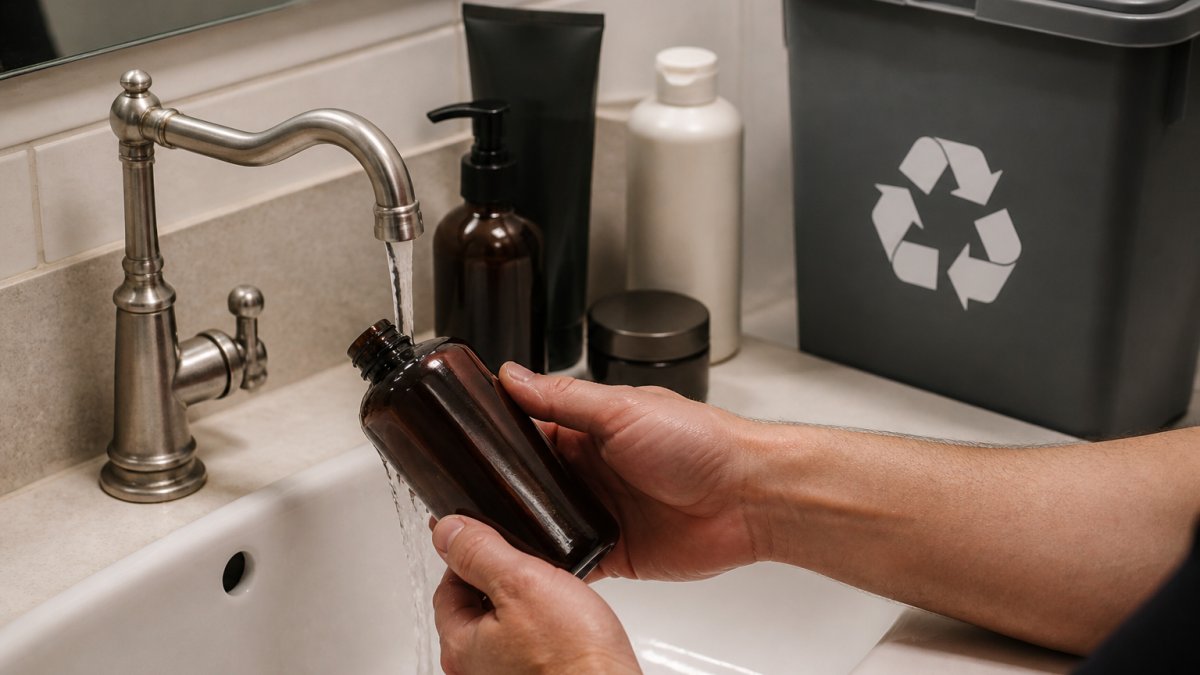
Rinse, Separate, and Check Local Rules
Here is the routine we recommend:
- Scrape out residue. Use a spatula or the last of the product. Product residue contaminates recycling loads.
- Rinse thoroughly. A quick rinse under the tap is enough for most containers. Let it dry.
- Remove caps and pumps. Separate components unless your council accepts them together.
- Check local acceptance. Rules vary by council. Look up your area's recycling guide before binning anything unusual.
- Squash and bin. Flatten bottles to save space, then place them in your recycling bin.
The official government guidance on recycling household waste sets out how collection rules differ by council, so always check your own authority's list first.
Watch out: leaving shampoo or cream residue inside a container can cause a whole batch to be rejected at the sorting facility.
Recycling Pump Bottles and Spray Tops Without the Guesswork
Pump bottles and spray tops are the most common recycling mistake in a bathroom.
The fix is simple: unscrew the pump, pull it apart if you can, and check whether your council accepts the plastic body. Many do not take pumps at kerbside.
- Pump bottles: Remove the pump, rinse the bottle, recycle the bottle. Bin the pump unless your council says otherwise.
- Spray tops: Separate the trigger or nozzle from the bottle. Recycle the bottle only.
- Trigger sprays: Often mixed plastic. Check before binning.
If your council rejects pumps, keep them aside for a specialist take-back scheme. We cover those below.
Recycling Aerosol Cans from Shaving and Styling Products
Aerosol cans from shaving foam and styling products are recyclable, but only when they are completely empty.
Empty the can fully, then check the label for the recycling symbol. Most councils accept empty steel and aluminium aerosol cans in the metal recycling stream.
Some councils ask for aerosols to be bagged separately or taken to a household waste site. The Health and Safety Executive guidance on aerosol disposal explains why pressurised containers need careful handling.
If a can still has product inside, use it up or take it to a local household waste recycling centre rather than the kerbside bin.
Razor Blade Recycling: What to Do with Blades and Cartridges
Razor blades and cartridges are a genuine recycling problem. They are small, sharp, and made of mixed materials, so most councils will not take them at kerbside.
You have three sensible options:
- Specialist blade banks. Some shaving brands and retailers offer take-back schemes for used blades.
- Household waste recycling centre. Check whether your local site accepts sharps or metal items.
- Wrap and bin as a last resort. Place used blades in a rigid container before binning to protect collection staff.
Never put loose blades in a recycling bin. They injure workers and damage sorting equipment.
If you are replacing blades regularly, it is worth reading our guide on how to shave without irritation so you get more shaves from each cartridge before it needs recycling.
Hard-to-Recycle Items and Specialist Take-Book Options
Some grooming packaging will never go in your kerbside bin. Sachets, flexible pouches, mixed-material packs, small-format travel containers, and anything coded 4, 6, or 7 fall outside most council collections. The mistake is to bin them out of frustration, the better move is to route them to a take-back scheme or a specialist recycler.
Which Items Need a Take-Back Route
- Flexible refill pouches and sachets. Multi-layer plastic that standard facilities cannot separate. Almost never kerbside recyclable.
- Small-format containers. Travel-size bottles and sample pots are often lost in sorting because they are too small to be captured.
- Mixed-material packs. Pumps with metal springs, spray tops with rubber seals, and tubes with aluminium barriers.
How Take-Back Schemes Actually Work
Store and brand take-back schemes collect hard-to-recycle packaging and send it to specialist processors. The mechanics vary, but the common patterns are:
- In-store drop-off. Some retailers place collection bins near the cosmetics or pharmacy counter. You bring clean, empty packaging on a normal shopping trip; the retailer consolidates it for specialist processing.
- Brand postal returns. A growing number of grooming brands run their own return schemes, sometimes with a prepaid envelope or a freepost address. Check the brand's website for a "recycling" or "take-back" page.
- Specialist recyclers by post or drop-off. Some facilities accept hard-to-recycle plastics by post or at a local drop-off point. Search for "hard-to-recycle plastic recycling" plus your council area to find the nearest option.
A practical habit is to keep a small box in the bathroom for items that cannot go kerbside, then take the box to a drop-off point once a month rather than binning each item as you finish it.
What to Do with Aerosols and Pressurised Containers
Aerosol cans from shaving foam and styling products are recyclable, but only when completely empty. A can with pressure left inside can cause problems at the recycling plant. Empty the can fully, then check the label for the recycling symbol. Most councils accept empty steel and aluminium aerosol cans in the metal recycling stream. Do not pierce or crush aerosols yourself.
The "Recyclable" Label Trap
Before you buy, check whether the packaging is genuinely recyclable in your area. A pack that says "recyclable" is not always accepted locally, the claim often refers to a theoretical end-of-life route rather than your council's collection list. The WRAP charity's guidance on packaging and waste offers useful context on how packaging waste is managed and where take-back schemes fit in.
Reuse and Repurpose Empty Containers Before You Bin Them
Reuse beats recycling when it is practical. A sturdy glass jar or a well-made tin can serve a second life around the home.
Here are some easy repurposing ideas:
- Glass jars: Store cotton buds, hair ties, or small tools.
- Tin containers: Use as a desk tidy or travel case.
- Small pots: Keep for travel-sized portions of product.
Only reuse containers that are clean and safe. A jar that held a strong fragrance may not suit food storage.
At 99 Ninety Nine, we keep packaging simple so it is easier to recycle or reuse. Our lightweight, wax- and butter-free formulas mean less residue left in the tube.
If you want grooming products that are easier to recycle and kinder to sensitive skin, 99 Ninety Nine makes fully recyclable, biodegradable tubes with formulas designed to reduce razor burn and irritation. Our lightweight, non-clogging products soften facial hair and leave skin moisturised without heavy waxes or butters. Get started with 99 Ninety Nine and build a grooming routine that is better for your skin and the planet.
Frequently Asked Questions
Do you need to rinse grooming product bottles before recycling?
Yes. Empty containers should be rinsed so no product residue remains, then left to drain and dry. A quick rinse stops residue contaminating other recyclables and keeps your bin cleaner. You do not need to scrub or sterilise anything; a swill with cold water is enough. Leave the cap off while it dries so trapped moisture can escape, then refit it before placing the bottle in your recycling bin.
Which bin do aerosol cans go in?
Empty aerosol cans from shaving foam or styling products usually go in your household recycling bin, but check your council's rules first because collection varies by area. The can must be completely empty, with the nozzle removed if possible. Never pierce or crush an aerosol can, and keep it away from heat. If your council does not accept aerosols at kerbside, take them to a local household waste recycling centre instead.
Can pump bottles and spray tops be recycled?
The bottle usually can, but the pump or spray top often cannot. Pumps contain metal springs and mixed plastics that most kerbside collections will not process. Remove the pump, rinse the bottle, and recycle the bottle if your council accepts that plastic type. Some specialist schemes accept pumps separately. If no take-back option exists, the pump goes in general waste. Check your local recycling map before assuming either part is accepted.
What should you do with grooming packaging that cannot go in household recycling?
Use a specialist take-back scheme where one exists, such as in-store collection points for razors, blades or cosmetic packaging. If nothing local accepts the item, it belongs in general waste. Do not put hard-to-recycle items in the recycling bin hoping they will be sorted out; they can contaminate a whole load. Keep a small separate container in the bathroom for these items so they do not end up mixed in with recyclables by mistake.

Share:
Affordable Men's Skincare Routine UK: 2026 Guide
How to Soften Coarse Beard Hair for a Smoother Shave